
Building Improv That Adapts From the Ground Up

On March 26, 2026, Rachel Garmon-Williams and Sim Rivers, Bridge 9's Director of Disability Programming, led a two-hour improv workshop at Virginia Tech for adults in the Virginia Department for the Blind and Vision Impaired's Blind Design Program. This was Bridge 9's second year partnering with the program.
We had an imaginary green ball going around the room. Players passed it back and forth, saying each other's names. Then one of us threw it as green slime. What would green slime feel like? What would you do? The room found out.
This was March 26th at Virginia Tech, and the players were adults in the Virginia Department for the Blind and Vision Impaired's blind design program — a week of learning about architecture, building 3D models, and asking what an accessible space could look like if they got to design it. Sim Rivers, our Director of Disability Programming, and I were brought in for a two-hour improv workshop on flexibility and resiliency. This was our second year doing it. They asked us back.

When Sim and I first taught this class last year, we had to figure out how to adapt our usual programming for participants who are blind or vision impaired. Improv is a flexible format, so the adaptations were adjustments rather than a rebuild. Passing an imaginary object means saying names so everyone tracks where the object is. Visual storytelling becomes a different kind of storytelling. The Fail Bow still works. Yes, And still works.
What we paid attention to last year, and again this year, was not limiting them. These are folks who are mostly blind or vision impaired from birth. They are not new to navigating the world. They are very used to playing. Our job as instructors was not to scale anything down. It was to keep the exercises open and trust that they would meet us there.
We had a few deafblind students this year. We adapted again — both Sim and I wore microphones that connected directly to their hearing aids, so we could communicate with them as directly as we were communicating with everyone else.
The thing that struck both of us most, though, wasn't the technical adaptation. It was watching how little space adults get to play. Some of our participants were 18, in their early 20s. Where in their week, in their year, in their life had someone said, "Okay, just be silly for two hours"? What does it look like to be goofy together? What does it look like to act together? For a lot of our students, this was new.
So we built the workshop around exploration. What if we tried this? What if we thought about that? We let the students guide us toward what they wanted to work on. They told us what they noticed. They told us what they picked up on. We worked a lot on storytelling — what is it to tell your own story, how do you tell it, what story do you want to be told. Those are questions that mattered to a group of people spending the week imagining what accessible design could be.
The people who run these programs often tell us we adapt well in the moment, which we appreciate, but that in-the-moment adaptation comes from something we do before the class starts. We build our lessons with intentionality. If you sit down at the front end and ask "what is this exercise for? why are we doing this?", then when an actual person walks in with an actual need, the answer to "how do we adapt this" is already there. The structure was built to flex.
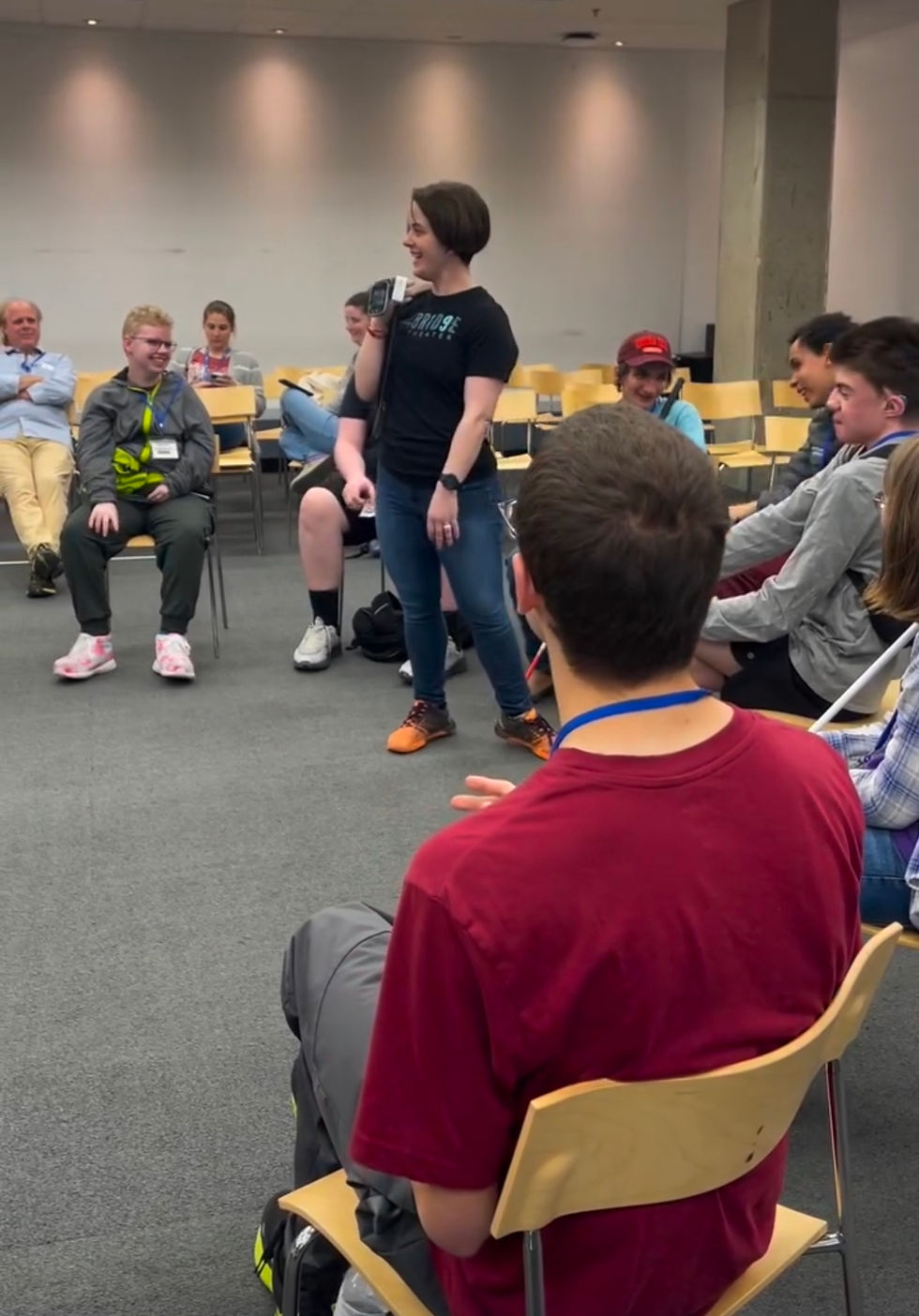
But we are never the only ones bringing something to the room. The blind and vision impaired adults we worked with have been adapting their whole lives. They navigate spaces designed without them in mind. They model flexibility every day in a way we get to practice for two hours and call a workshop. So when we say improv teaches flexibility and resiliency, we should also say that our students teach us. That exchange is the work. That is the bridge.
The Virginia Department for the Blind and Vision Impaired does a lot of great work in this region — programming and training for folks who are blind, vision impaired, or who haven't been given the tools to access the world. We are grateful to be one of the partners they invite in. And if your organization serves a community we haven't met yet, and you're wondering whether improv could fit your programming, reach out. We would love to figure it out with you. The answer is almost always Yes, And.
Bridge 9 Theater is a Richmond-based 501(c)(3) improv company. To learn more about partnerships, professional development trainings, or accessibility workshops, visit bridge9theater.com/inclusion or email rachel@bridge9theater.com.


Comments